Fiserv Valuation Dive Deep
The best way to learn business valuation is by doing it. I am evaluating the Fiserv, INC using sum of parts like a private business deal and using DCF.
Disclaimer: This is not a financial advice, and only for educational purpose.
Note: I have greyed out my investment framework.
To do this, I’ll be using two distinct frameworks: 1.The Private Business Owner Perspective: Treating the company as a collection of individual businesses. 2.The Aesop Framework: Using the classic “bird in the hand” proverb to determine value.
Intrinsic value
The present value of all cash flows it can generate from now until its “judgment day” (forever), discounted back to today at a proper rate.
Note: Our goal is to be directionally correct and not precisely wrong.
Valuating it like a private business deal
This is essentially valuating the company like a private business owner will do. He will first list all the main business units (within the company) that is responsible for the owner’s earning’s, and then he will go on to valuate each part.
Valuating like Aesop
This is what we learnt early in school as a proverb - “a bird in the hand is worth two in the bush”. This is essentially taught to every 1990s kid growing up in a middle class family in india. The extension of this becomes the complete investment philosophy - 1.How certain are you that there are birds in the bush? 2.When will they emerge and how many will there be? 3.What is the risk-free interest rate (the cost of waiting)?
Fiserv valuation like a private business deal
Business breakdown
Fiserv has two main earning drivers -
- Merchant Solutions - This is focused on helping business accept payments and manage operations.
- Financial Solution - This is focused on providing core banking software for banks and credit unions.
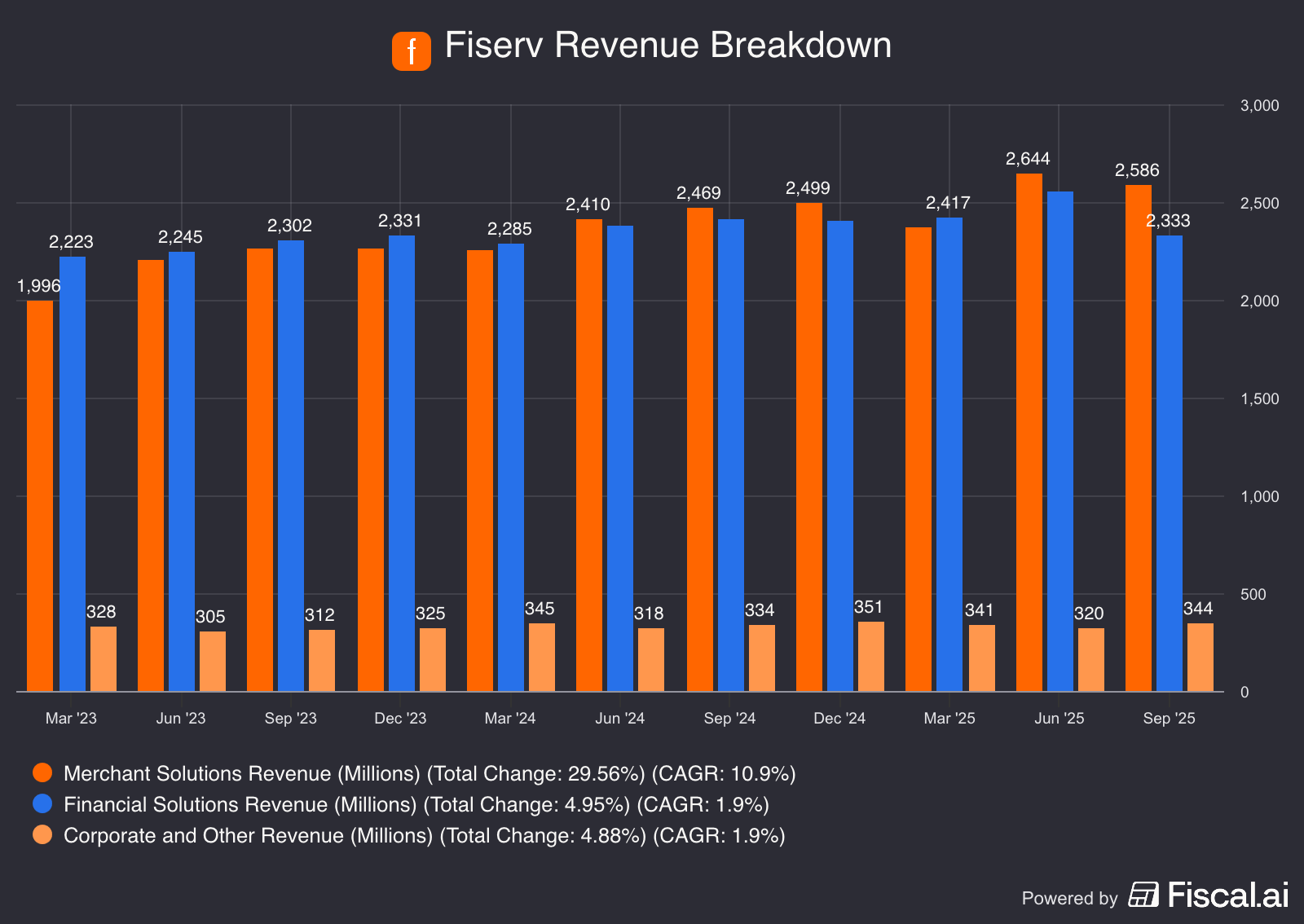
Fiserv Merchant Solutions - Dive deep
Merchant solution business brings in ~10 billion in revenues annually, which can be further breakdown into revenue coming from -
- Small Business (product: Clover) - accounts for ~67% of merchant business line, and overall ~32% of total revenue.
- Enterprise (product: Carat) - accounts for ~23% of merchant business line, and overall ~10% of total revenue.
- Processing fees - accounts for ~10% of merchant business line, and overall ~5% of total revenue.
Small Business (Clover)
Clover is the cloud based point of sale solution which serves ~800,000 small and medium size business (SMBs) globally resulting in ~$337B in annual volume. It is customized to serve -
- Food & beverage - with custom features like top performing dish, manage staff, payroll and scheduling, online order, etc.
- Retail - with custom features like track revenue reports, customer journey, inventory management, stocking, etc
- Services - with custom features like loyalty programs, bookings, manage staff, revenue reports etc
Clover essentially charges in three basic models -
- Starter - $179/mo for 3 years, and transactions fee (tap 2.3% + 10¢, online 3.5% + 10¢), and get rapid deposit at 1.75% fee;
- Standard - $239/mo for 3 years, and transactions fee (tap 2.3% + 10¢, online 3.5% + 10¢), and get rapid deposit at 1.75% fee;
- Advanced - $354/mo for 3 years, and transactions fee (tap 2.3% + 10¢, online 3.5% + 10¢), and get rapid deposit at 1.75% fee;
Competition 1: Square
- Free - $0/mo/location, and transactions fee (tap 2.6% + 15¢, online 3.3% + 30¢), and get rapid deposit at 1.75% fee;
- Plus - $49/mo/location + order management app($30/mo/device for KDS, $50/mo/device for kiosk app) and transactions fee (tap 2.5% + 15¢, online 2.9% + 30¢), and get rapid deposit at 1.75% fee;
- Premium - $149/mo/location + order management app($20/mo/device for KDS, $30/mo/device for kiosk app), and transactions fee (tap 2.4% + 15¢, online 2.9% + 30¢), and get rapid deposit at 1.75% fee;
Competition 2: Toast Plans are more customizable with the following price structure
- Basic - $0/mo with 3.09% + 15¢/card transaction or $69/mo with 2.49% + 15¢/card transaction
- Core - $0/mo with 3.39% + 15¢/card transaction or $219/mo with 2.49% + 15¢/card transaction
- Growth - $0/mo with 3.69% + 15¢/card transaction or $578/mo with 2.49% + 15¢/card transaction
Hidden in terms/conditions for traditional - Lower average card transaction fees—
- 2.49% + 15¢ card transaction fee on most card purchases. Exceptions follow:
- 3.50% + 15¢ card transaction fee for Visa, Discover, and Mastercard Card-Not Present.
- 3.50% + 15¢ card transaction fee for American Express.
More or less all three looks like charging similar fee structure with only differentiation is software and network. I find this business very sticky as customers will not likely change their POS structure given their historical data will start to get locked in with the vendors.
Anecdotes to Reddit -
- Reddit - Average full service restaurant: Why Choose Toast vs. Square/Clover/Other POS?.
- Reddit - bubble tea shop: Clover vs Square vs Toast POS system?
- Reddit - Cafe POS: Square vs. Toast vs. Clover?
- Reddit - Toast vs Clover?
- Reddit - Would you rather own your own POS system or stick with Square/Toast?
- Reddit - 2 Brick Oven Pizza shop: Toast VS Clover
- Reddit - Toast vs Square
- Reddit - Is Toast Worth the Extra Cost?
- facebook - TOAST VS. SQUARE for small restaurant with no modification or marketing/payroll needs
Anecdotes from blogs -
- Substack - Clover vs. Square vs. Toast Dive Deep
- Shopify - What is a POS system for a small business?
- youtube - Clover POS features dive deep
- youtube - The Best Free POS Systems For Small Businesses
- youtube - Clover POS Review - The Good, The Bad & The Ugly
- youtube - The Best POS Systems
Summary from reading the above :
- Toast users are very happy with their functionality, and overall experience. Only con is it can be costly and reddit users suggested negotiating the price.
- Square is ok to use and most of the complaints is that its outages caused them lost revenue and frustration.
- Clover users mentioned its only pro is cost. Most users hated its customer and sales service. They mentioned use clover only if you get a good sales rep.
- Switching cost is their but people have asked questions like I am using X and want to switch. This means if your POS is not good, customer will switch post their contract period.
- Anecdotally, most questions were from restaurant owner, which makes me think that is the restaurant the biggest market for POS owners.
Thinking from business owner point of view who wont be spending too much time thinking about POS. I asked Google AI mode Which POS to use for small restaurant owner with 5000$ revenue/mo or with 10,000$ revenue/month, or with 20,000$ revenue/mo
Google AI suggested Square as the first option <10,000$ rev/mo with reasoning as more budget friendly option and Toast as best for growth or for industry specific functionalities. It switches to Toast as best option for $20k revenue.
After the research for restaurant business, I myself would have gone with Toast. For retail, it would be close call and would have preferred Sqaure over Clover for simple reason that I had to depend on the sales person’s character as compared to companies reputation. :(
Enterprise (Carat)
Carat is an enterprise payment orchestration and omnichannel commerce. I expect this business to be quite sticky and stable in terms of earning and revenue. Getting new customers might be hard with tough competition from other Stripe, Adyen, worldpay, J.P. Morgan Payments etc.
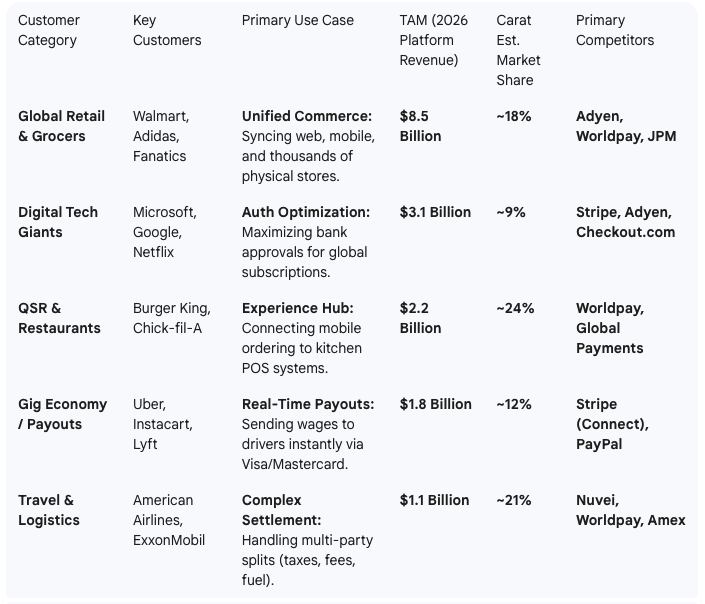 Source: Handholding Gemini AI to build above table, so its a probabilistic table not a deterministic one.
To understand Carat, I need a reference point which I am more familiar with, i.e. Stripe. The following comparison can help understand:
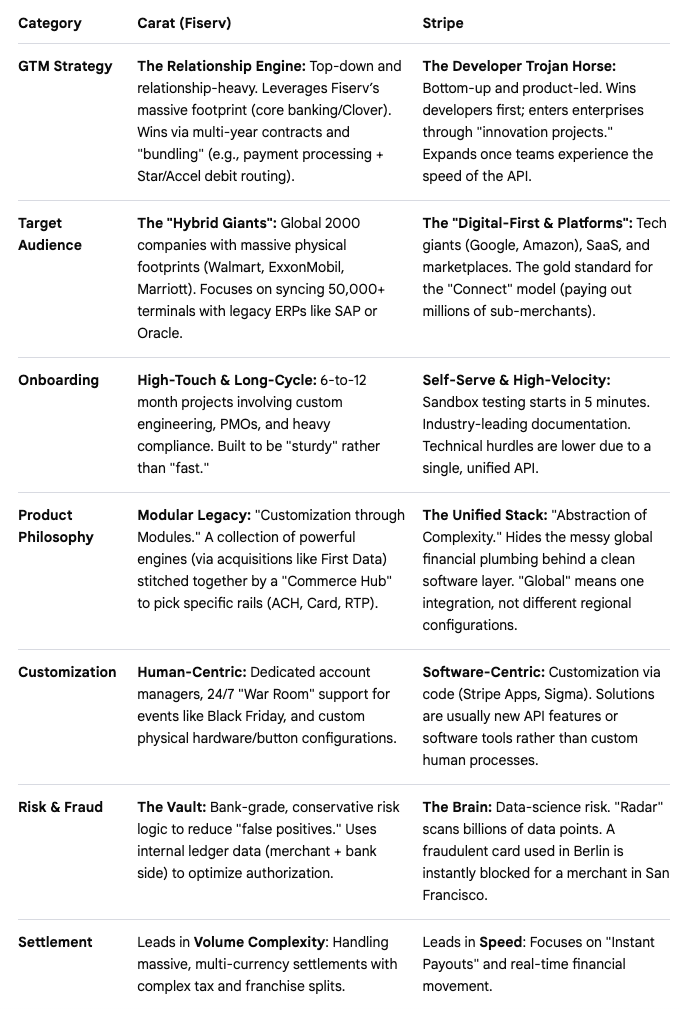 Source: Handholding Gemini AI to build above table, so its a probabilistic table not a deterministic one.
Overall this too is a sticky business, but growth will depend on the operational quality of their software. With rise of Stripe which is a phenomenal product with smart founder, it will be a tough fight on growth. I checked Stripe next target is going after big established organizations like church of England, Oxford, Hershey etc
Fiserv Financial Solutions - Dive deep
This is the legacy product from fiserv growing at 2-3% / year. Its a bank core processor, operating in a duopoly market with Jack Henry, serving smaller financial institutions such as community banks and credit unions. It has three business lines -
- Digital payments - represents 40% of the financial business and 20% of overall revenue, which is growing at 3%. This
provides debit card processing services; debit network services; security and fraud protection products; bill payment; person-to-person payments; and account-to-account transfers. For example - Zelle, CheckFree, and Popmoney. - Issuing - represents 33% of the financial business and 16% of overall revenue, which is growing at 7%. This provides credit card processing services; prepaid card processing services; card production services; print services; government payment processing; and student loan processing. For example - VisionNext, Star/Accel networks.
- Banking - represents 24% of the financial business and 11% of overall revenue, which is declining at 2%. This provides customer loan and deposit account processing; digital banking; financial and risk management; professional services and consulting; and check processing. For example- DNA, Finxact (Cloud Core), and XD (Digital Banking).
Conclusion - Valuation as sum of parts
The main growth factor for Fiserv will be coming from merchant solutions business where market is quite fragmented and there is a place for someone to come and fill the gap. The stability in earnings can be contributed to their Financial solution business which has been sticky for decades and is quite reliable.
As a hardcore engineer, my mind is wired to think about worst case scenario and problems before thinking about what to solve. Here are my thoughts:
- Turnaround is business is easies then turning around the culture. Once the culture is gone its very hard or impossible to change. For last 3-4 years the previous CEO have incentivised the employees to think short term, and would assume their performance was tied to it. In this scenario based on personal experience - “A” players leave and “B” players stay and hire “C” players. That is employees responsible for doing real work will quickly gets diluted in character either through employee churn or human adaptive nature. New CEO if walks the talk will have a tall order to bring back the “new better” culture.
- Quantifying lost of trust is hard, If the merchants who were burnt by using Clover or other services will work hard to save/convince their community from their products. This is evident from reddit answers. New CEO will have to execute the hell out of it to earn the trust back.
- Intense competition in both the earning drivers of merchant solutions.
- High switching cost, but highly dependent/directly proportional on the earning power of its clients.
- In high inflation environment, there will be more volume but cutting the noise is important to see margin in dollar terms.
- High debt and high GoodWill.
Lets first breakdown the revenue, operating earning and calculate real margins -
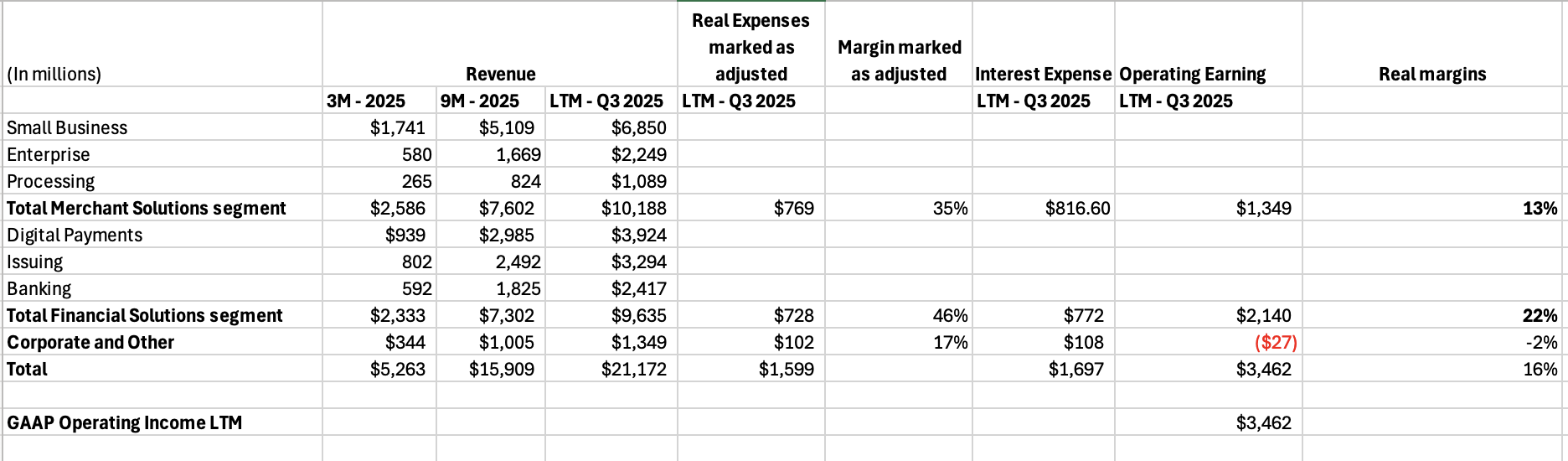 Fiserv sum of parts breakdown.xlsx
To come with operating earning is simple = revenue - all expenses. For “Real Expenses marked as adjusted” and “adjusted
margin” I simply got from from page 12 of the investor presentation.
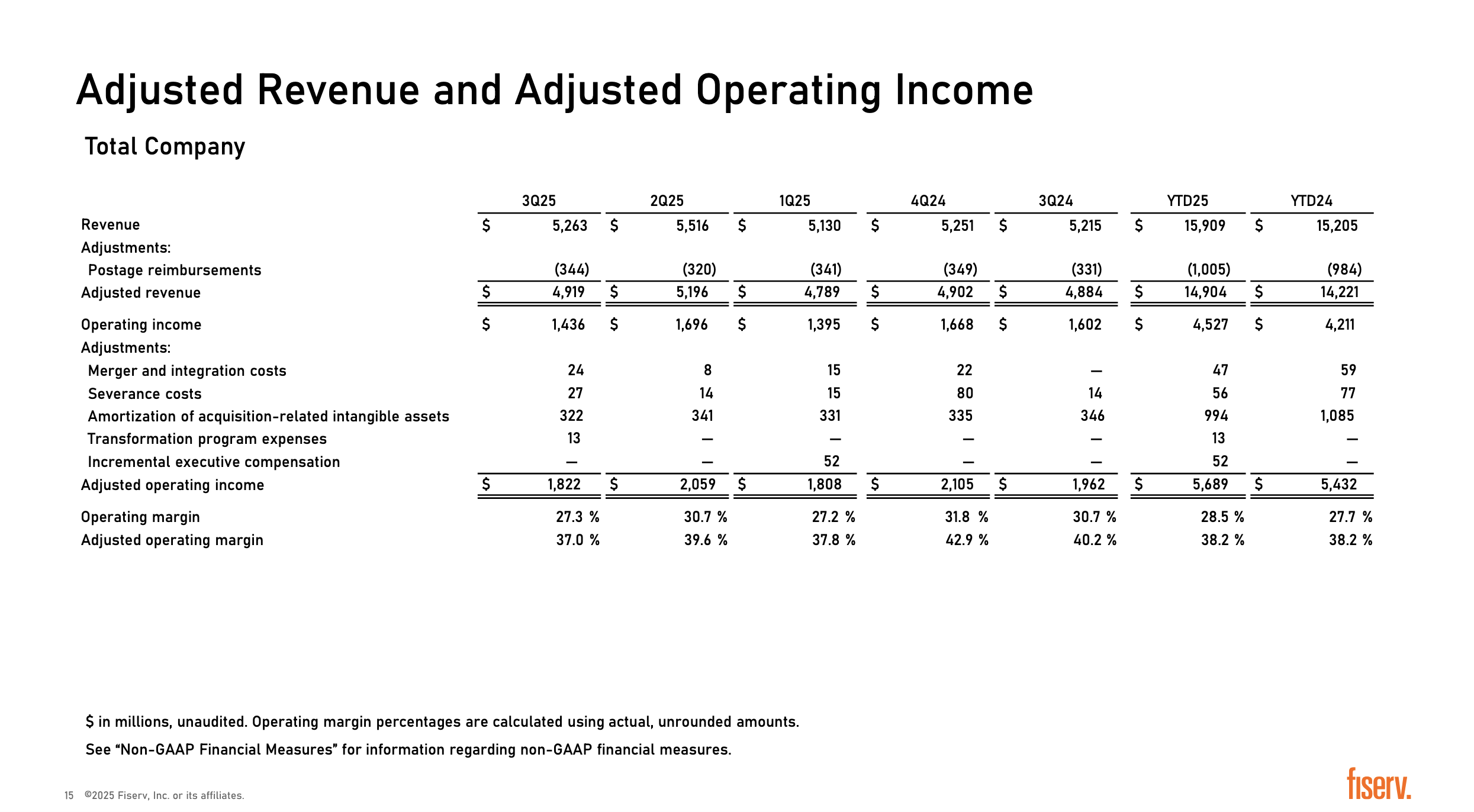
For interest expense I divided the interest payment in proportion to the revenue % of the segment. For income tax i used flat 18.4%.
Now the valuation part
- Merchant solution - I see its earning ~$1.3 billion, with multiple of 10 will give valuation of $13 billion.
- Financial Solution - I see its earning ~$2.1 billion, with multiple of 5 will give valuation of $10 billion.
I think as a private deal I will be seeing the business is worth ~$23 billion and have ~30 billion of debt. Its a high risk and high reward kind of business with a tough job ahead for new management. It will all depend on the execution.
Fiserv valuation like Aesop
Let’s go deep into converting the philosophy to practice. What we defined in philosophy is a simple present value calculator. PV = FV / (1 + r)^n PV: Present Value FV: Future Value r: Rate of return (interest rate or discount rate) per period n: Number of period
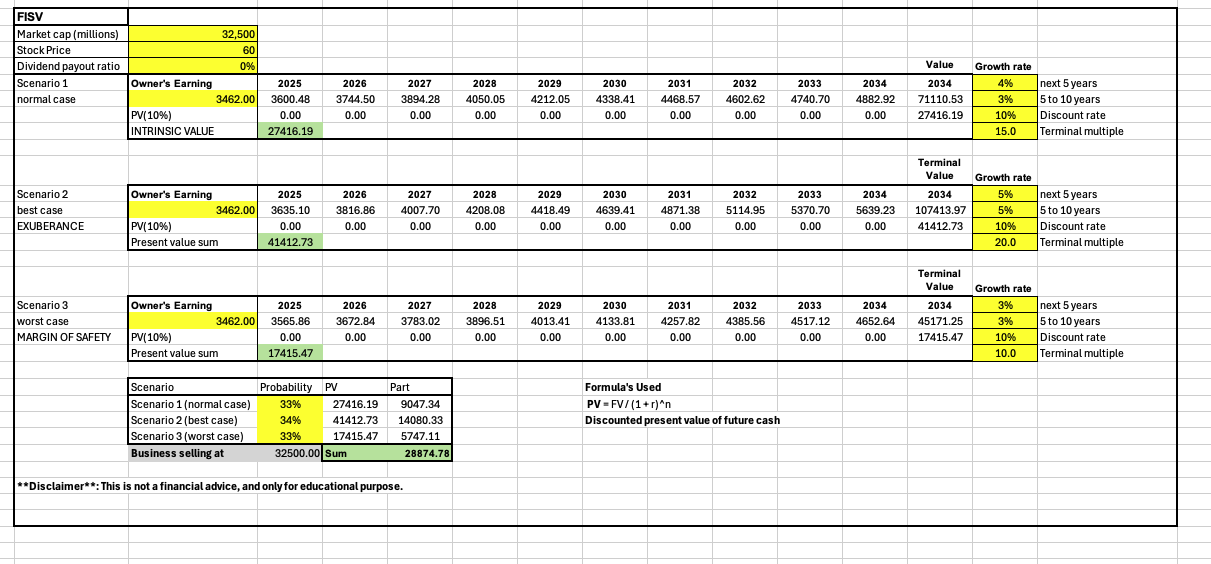
Owner’s earning
Owner’s earning is defined as the cash flows that can be distributed to owners after the business has paid all expenses and capital expenditures for the investment. Owner Earnings = (a) Reported Earnings + (b) Depreciation, Depletion, Amortization, and other non-cash charges - (c) Average Annual Maintenance Capital Expenditures
For Fiserv, its earning $3462 million in last 12 months.
Terminal multiple
The terminal value is an estimation of cash you get in the last year of the assumed ownership of the stock. To get the
estimation of selling price we can multiply the owner’s earning of last year with the terminal multiple.
It is impossible to predict the terminal multiple (P/E ratio) at the end of ownership. All we can do is estimate based on
the company, its story, and likelihood of its survival.
We need to keep things simple, we can do one of the following things -
1/ Use historical range P/E of S&P500 (7 and 30 - Source: Multpl),
2/ Use historical range of its industry,
3/ Check the historical range of the P/E of the business itself,
3/ too hard pile :)
I simply took 10, 15, 20 as the terminal multiple.
Discount rate
The discount rate is essentially defining the risk you are taking while owning the stock over 10-year rate on the US Treasury. I keep my life simple and keep it at as 10% for most of the developed country. I came around this after scanning through all the annual meeting and letters from Berkshire Hathaway. If you wish you can complicate your life by learning risk free rates as taught in college MBA with concepts like Weighted Average Cost of Capital (WACC) or cost of equity using capital Asset Pricing Model. You can watch Session 4 to Session 7. I watched it and decided to simplify for my use case.
I keep my life simple based on the universe of business I am looking at - 10%.
Growth rate
For coming up with growth rate, you need to dive deep to understand the business. I have divided the growth rate into
two buckets - 1/ first 5 years, which will be closer to current rate, 2/ 5-10 years, that will require more imagination.
Of-course, its impossible to predict future growth, thus we have three scenarios - normal case, exuberance (best case)
and margin of safety (worst case). Here ideally one should write down 1 paragraph story for each case defining what
should future looks like to meet the defined case. The paragraph should be constructed with both risk and reward.
Thinking about risk is critical to the story.
I simply took 3, 4, and 5% growth using companies guidance.
Dividend payout ratio
Dividend payout is the percentage of a company’s earnings paid to shareholders as dividends. While calculating present value we need to add the dividend payout ratio as that earning is paid to the shareholder.
Inverted thinking - How much Fiserv need in revenue to justify current market pricing
Fiserv has a
- current market cap - ~$31 billion,
- net margin - ~16%,
- Revenue - ~$21 billion,
- Avg ROE (last 5 year) - ~9.1%
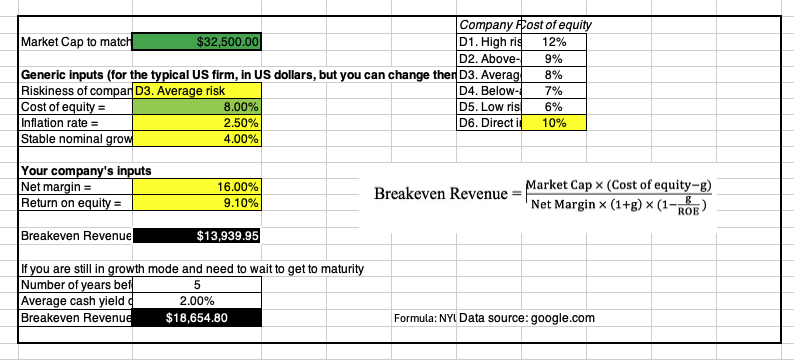
Now based on above break even revenue to justify market cap of ~$31 billion is ~$18 billion, which it already is earning. That means its fairly valued, and don’t need a fairy tale to justify the earnings.
Reference
Disclaimer
This is not a financial advice, and only for educational purpose.